

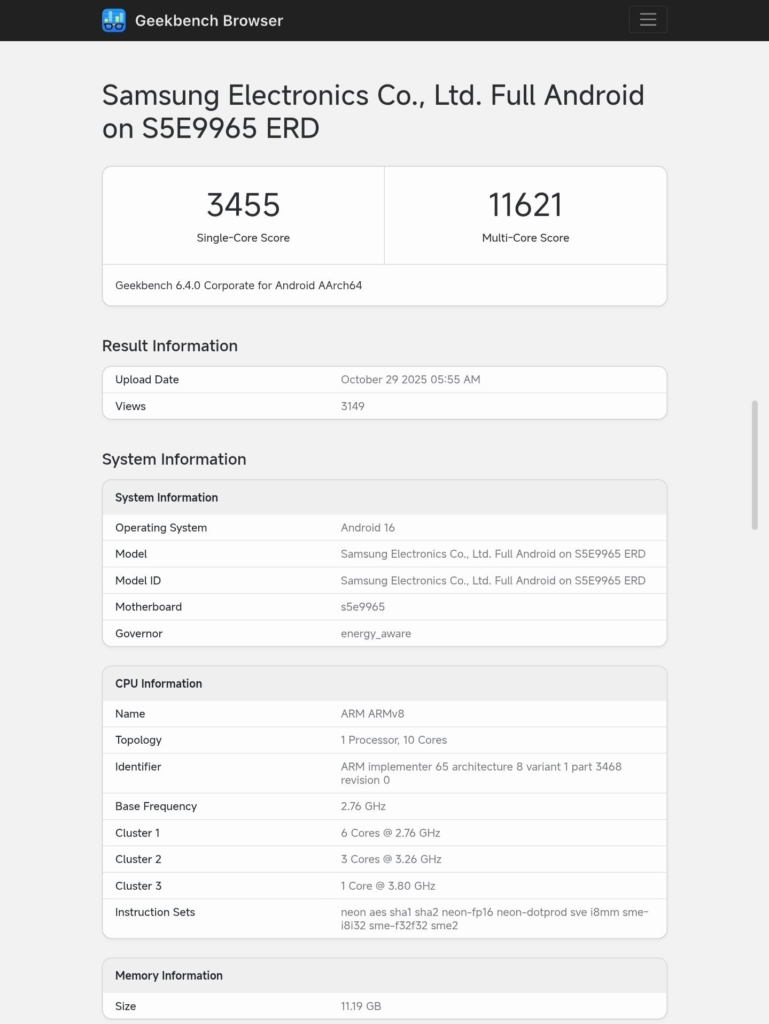
Samsung’s upcoming Exynos 2600 SoC has made a surprising appearance on Geekbench, revealing flagship-level performance that appears close to Qualcomm’s Snapdragon 8 Elite Gen5. The tested model, listed as Samsung Galaxy S26 (S5E9965 ERD), achieved 3455 single-core and 11621 multi-core, based on Geekbench 6.4.
The processor uses a 10-core CPU architecture in a 1+3+6 layout, with the highest-performing core reaching 3.8GHz, according to the benchmark listing. The test device runs Android 16, confirming that development work is already well underway.
The Geekbench Browser screenshot lists the chip as (Samsung S5E9965 ERD), achieving 3455 single-core and 11621 multi-core, using a 10-core CPU up to 3.8GHz, running Android 16, strongly suggesting this is an early Exynos 2600 engineering sample.
2nm Process Advantage
One of the most interesting details is manufacturing: the Exynos 2600 reportedly uses Samsung’s new 2nm GAA process, while the Snapdragon 8 Elite Gen5 is expected to be built on a 3nm node. Theoretically, a smaller process should provide better power efficiency and sustained performance, especially during gaming and heavy multitasking.
Long-Running Performance
Exynos chips have traditionally been viewed as slower or less efficient than their Snapdragon counterparts. However, with higher efficiency and better thermals expected from the 2nm node, Samsung could finally challenge that perception if mass-produced devices maintain performance without aggressive throttling.
Early Geekbench Comparison
| SoC | Single-core | Multi-core |
|---|---|---|
| Exynos 2600 (leaked) | 3455 | 11621 |
| Snapdragon 8 Elite Gen5 (expected) | ~3400 | ~12000 |
| Exynos 2500 (previous gen) | ~2350 | ~8,200 |
Note: Snapdragon 8 Elite Gen5 figures are based on earlier leak estimates.
Still a prototype
As always, these numbers belong to an engineering development platform, so final performance on retail Galaxy devices may vary. Samsung’s mass-production timeline is still unclear, although earlier reports suggested that the company may delay the rollout to further refine efficiency and yields.